

What is a PCS (Power Conversion System) in Battery Energy Storage?
When engineering or investing in a commercial or industrial Battery Energy Storage System (BESS), most discussions naturally center on cell chemistry, thermal management, and total megawatt-hour capacity. However, raw battery cells store energy as Direct Current (DC), while the industrial loads and electrical grids we rely on daily operate exclusively on Alternating Current (AC). Without a robust mechanism to manage this digital-to-analog-like interface, an advanced battery bank remains essentially isolated and unusable.
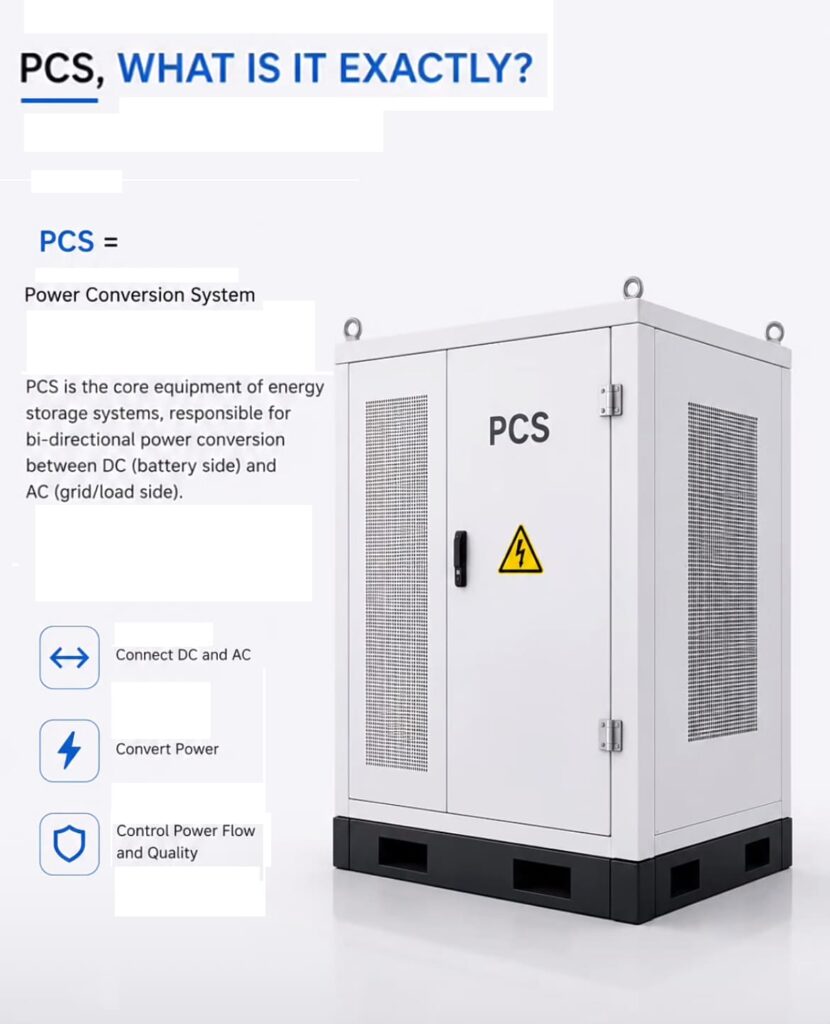
This is where the Power Conversion System (PCS) comes into play. Often referred to as the “brain,” the “bridge,” or the “core executor” of a modern energy storage setup, a PCS is the heavy-duty hardware responsible for the bi-directional conversion of electricity between DC and AC environments. If your goal is to understand how modern energy storage assets maintain grid stability, protect onsite machinery, and maximize your return on investment (ROI), mastering the mechanics of the PCS is your first step.
The Core Definition: What Exactly is a PCS?
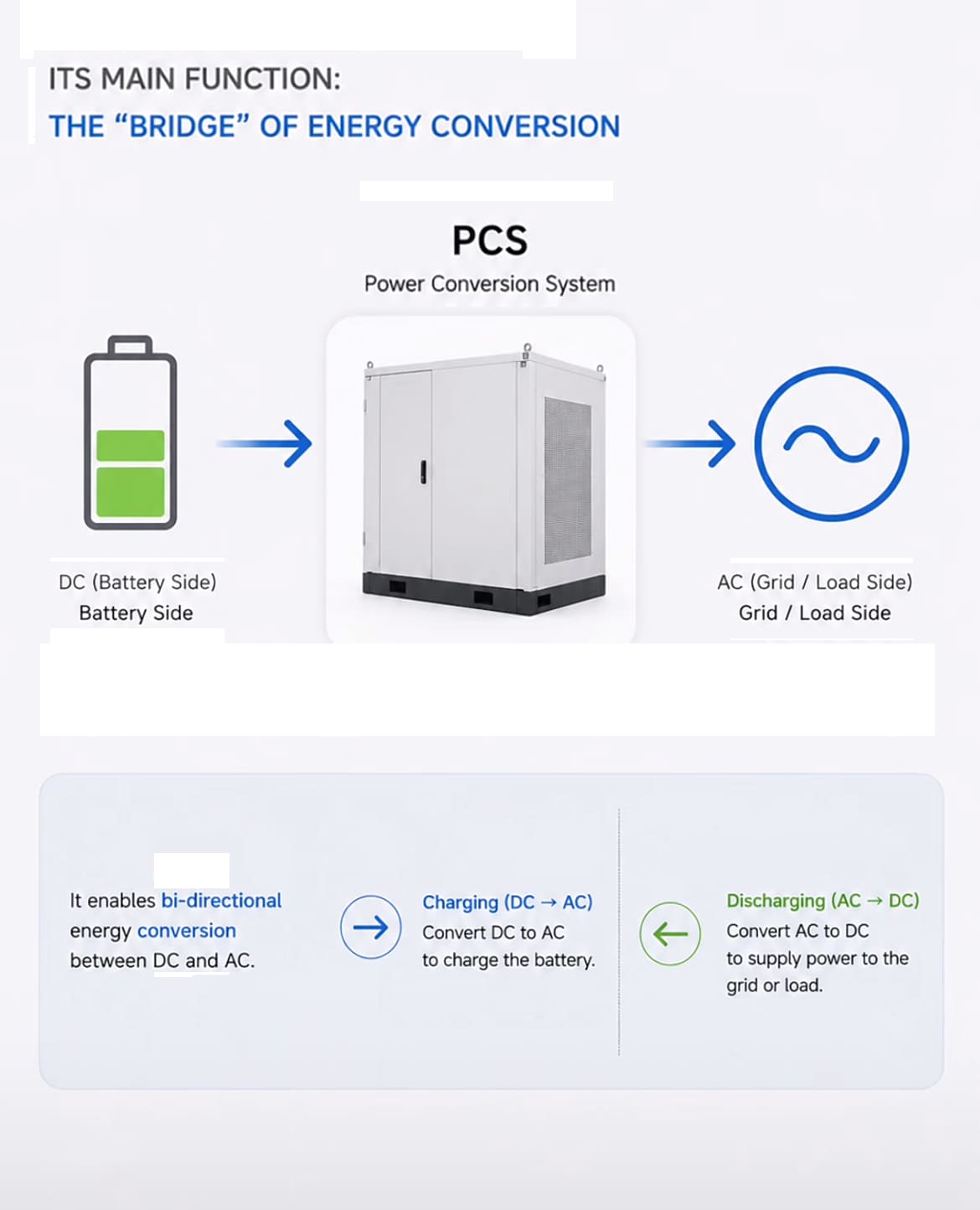
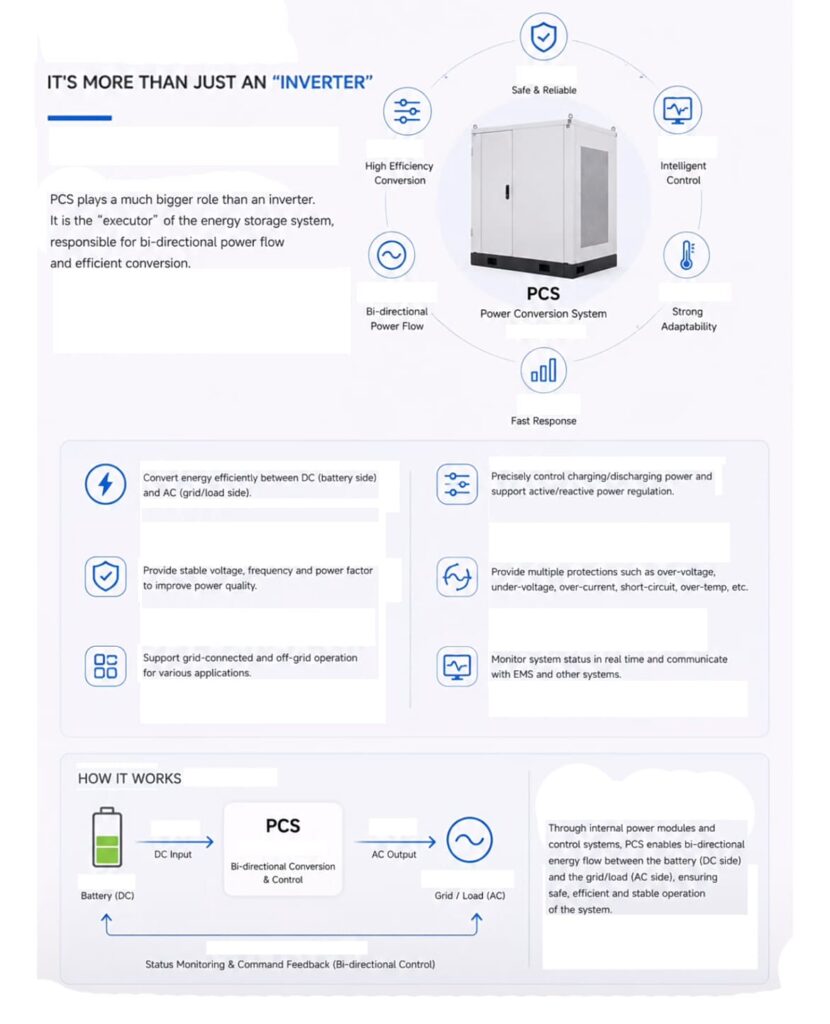
At its simplest, a Power Conversion System (PCS) is a high-power device situated between the battery side (DC) and the grid or facility load side (AC). It does not merely change the form of the current; it serves as a dynamic controller of power flow. A PCS ensures that electricity moves safely, efficiently, and instantaneously in either direction depending on shifts in utility pricing or onsite power demand.
To evaluate a commercial-grade PCS, project managers generally look at three fundamental capabilities:
- Direct DC and AC Connectivity: Acting as the primary physical and electrical gateway that hooks up the chemical storage infrastructure to external power lines.
- Efficient Power Conversion: Minimizing thermal and electronic losses during the inversion process to maximize the system’s overall round-trip efficiency (RTE).
- Active Power Flow and Quality Control: Regulating voltage, frequency, and phase alignment to make sure the output electricity matches the stringent, non-negotiable requirements of local utilities.
How It Works: The Bi-Directional Bridge
Unlike traditional power supplies or older generation assets that only push energy forward, a BESS PCS operates on a unique bi-directional topology. It actively switches between two primary operational modes in a fraction of a second:
1. Charging Mode (AC to DC Conversion)
When the system receives a command to store power—such as during late-night off-peak hours when factory electricity rates drop, or when onsite solar arrays generate more power than the facility can consume—the PCS draws AC power from the grid or local generation. It then converts this AC power into highly stabilized, finely tuned DC power to safely charge the battery banks without degrading the cells.
2. Discharging Mode (DC to AC Conversion)
Conversely, during peak demand periods, emergency grid outages, or high-tariff windows, the batteries must release their stored energy. The PCS extracts DC power from the battery racks, converts it back into premium-quality AC power, and injects it right into the local facility load or pumps it directly back out to the public utility grid for financial credits.
This constant feedback loop is managed through high-speed digital controllers paired with internal power electronic modules (typically advanced IGBTs or Silicon Carbide MOSFETs), allowing the system to react instantly to microsecond-level microgrid fluctuations.
Beyond Conversion: The Vital Functions of a Modern PCS
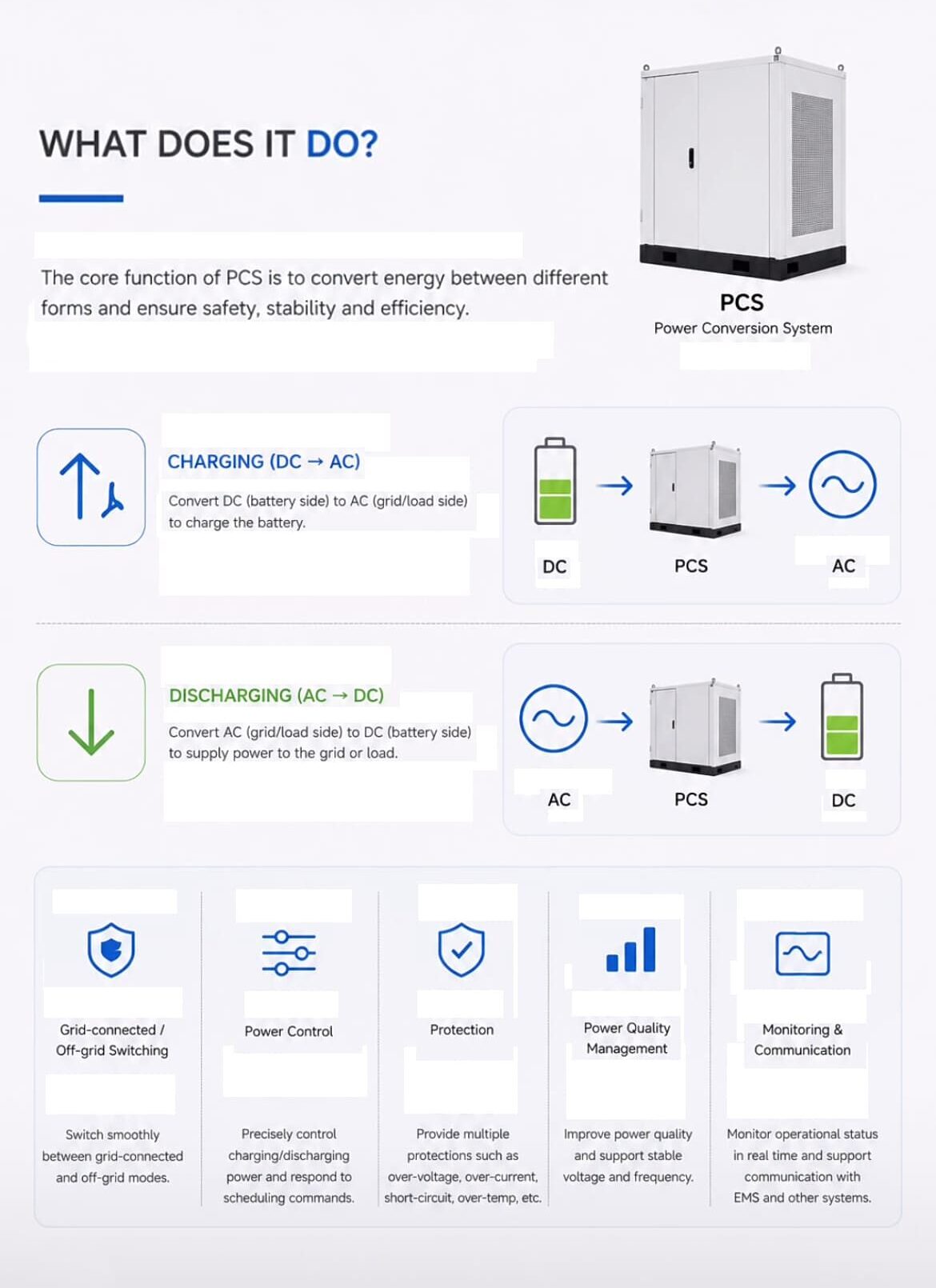
Calling a PCS a basic “converter” oversimplifies its actual contribution to a commercial project. In real-world field deployments, a commercial-grade PCS acts as a comprehensive, multi-tasking system manager that performs several critical operations simultaneously:
| Core Function | What It Delivers in Practice |
| Grid-connected / Off-grid Switching | Enables seamless microgrid transitions. During a sudden black-out, the PCS shifts into islanded (off-grid) mode within milliseconds to maintain backup power, then re-synchronizes seamlessly when the main grid recovers. |
| Precision Power Control | Accurately regulates both active power (kW) and reactive power (kVAR) outputs based on external dispatch commands, peak-shaving schedules, or real-time site monitoring. |
| Comprehensive Protection | Acts as an electrical shield, featuring heavy-duty, built-in structural safeguards against over-voltage, under-voltage, over-current, phase loss, short-circuits, and over-temperature events. |
| Power Quality Management | Actively filters out harmonics, stabilizes localized voltage sags, and maintains correct frequency alignment, keeping downstream sensitive automated machinery safe. |
| Monitoring & Communication | Maintains a non-stop, reliable data link with the Energy Management System (EMS) and Battery Management System (BMS) via industrial protocols like Modbus or CAN, feeding back system telemetry. |
PCS vs. Standard Inverter: What is the Real Difference?
A common point of confusion among procurement officers in the commercial energy sector is the distinction between a standard solar inverter and a storage-grade PCS. While both handle DC-to-AC conversion, their internal architectures, software baselines, and applications are completely distinct.
Standard Solar Inverters are inherently uni-directional devices. Their sole purpose is to take the raw DC power harvested by photovoltaic (PV) solar panels and convert it to AC power for immediate local consumption or grid export. They cannot take power back from the grid to feed the panels, nor do they possess the complex sub-systems required to regulate battery state-of-charge.
A Power Conversion System (PCS), by contrast, is fully bi-directional. It is built from the ground up to interface with active energy reservoirs like battery banks. A PCS is far more complex; it requires sophisticated control algorithms to balance battery health with grid demands, handles dual-direction power lines, and features advanced multi-mode operational logic. While a standard solar inverter focuses almost entirely on generation efficiency, a BESS PCS prioritizes structural safety, bidirectional control flexibility, and intelligent energy asset management.
Real-World Deployment: Top Application Scenarios
Because the PCS determines exactly how and when power is transferred, it is the defining component that dictates the commercial feasibility and financial payback period of energy storage across various global sectors:
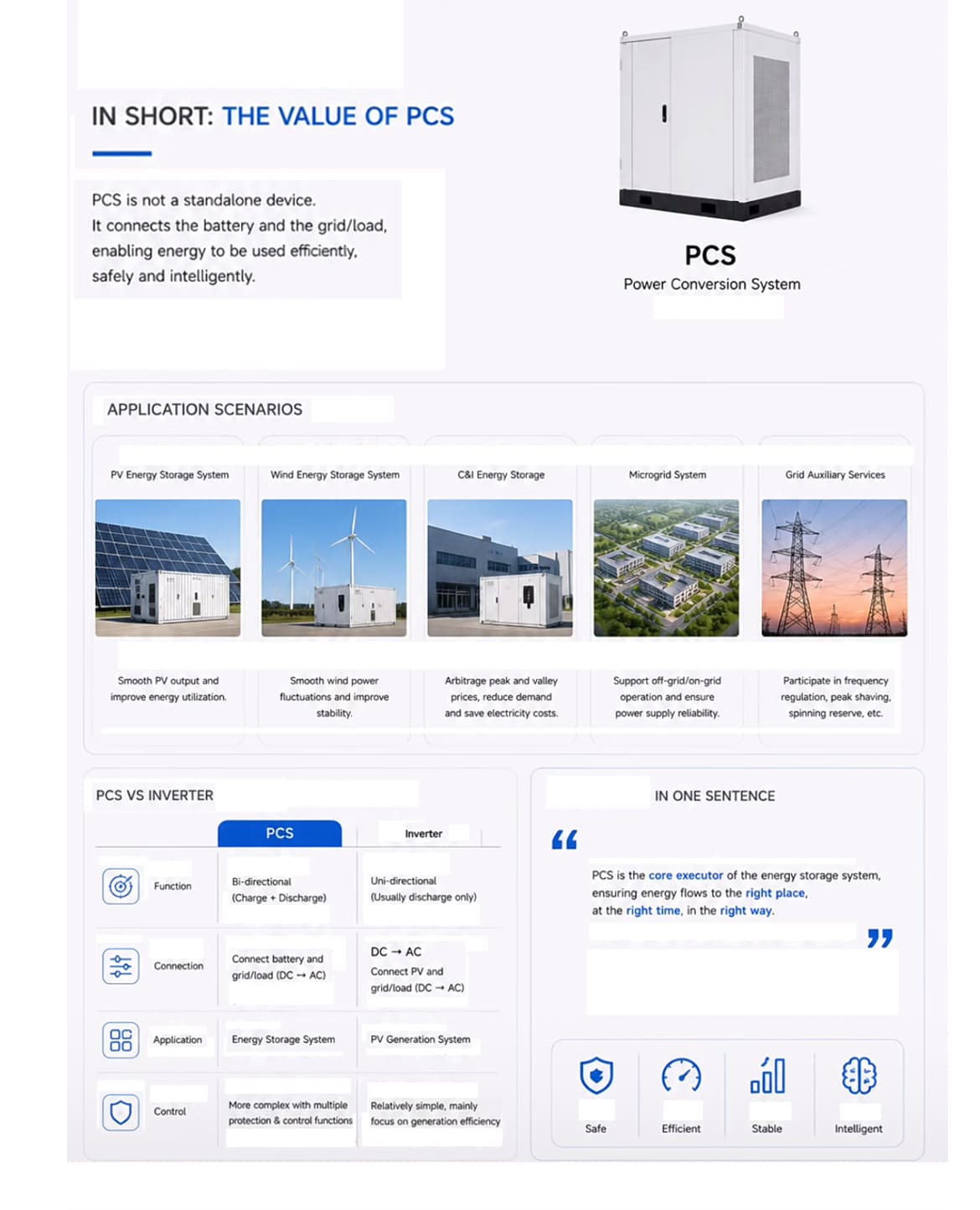
A Power Conversion System is not a minor, optional accessory in the energy transition; it is the core executor that transforms a passive box of battery cells into a highly profitable, dynamic power asset. By ensuring that energy flows to the right place, at the right time, and in the right format, a high-quality PCS delivers the ultimate value metrics for modern energy projects: safety, efficiency, stability, and intelligence.